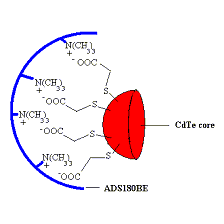
Anti-Aggregation Effect in Conjugated Polymers using Quantum Dots Nano-Assembly Light emitting conjugated polymers are a new class of materials with similar optical properties to those of inorganic semi-conductors. Their low synthesis cost and ease of processing make them extremely good candidates for applications in flat panel and large surface display technologies. However, low photoluminescence quantum yield in the solid state caused by aggregation quenching of the excited state is an important limiting factor that has hindered industrial applications. In order to solve this problem, many different strategies have been developed, focusing on the chemical modification of the main conjugated chain with bulky side groups or end-capping agents, but the charge transport properties of the materials are greatly impaired by such modifications. In collaboration with Dr. M.T. Nguyen of ADS, Inc, we have made negatively-charged CdTe quantum dots to efficiently counterbalance the pi-stacking in such conjugated polymers. The high surface area of quantum dots maximizes the ionic interactions with the polyelectrolytes at relatively low loading levels. The photophysical properties of these assemblies were studied by UV-visible and fluorescence spectroscopy and correlated to the level of aggregation in the conjugated polymer. Such an efficient displacement of pi-stacking by competitive positive interactions constitutes the first example of positive aggregation modulation. |
 |
|---|